Mastering the Marketplace by O'Neil-Henry Anne
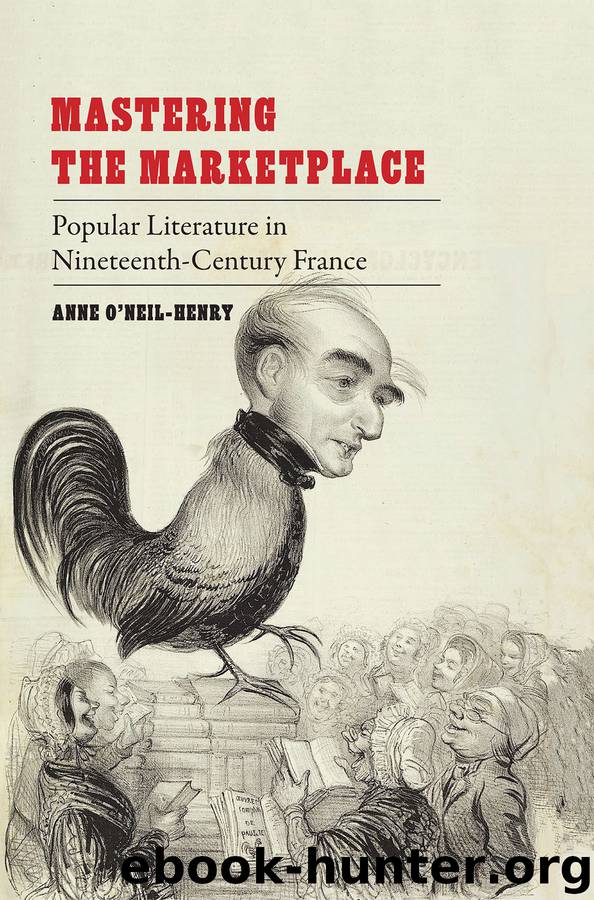
Author:O'Neil-Henry, Anne [O'Neil-Henry, Anne]
Language: eng
Format: epub
Tags: HIS013000 History / Europe / France, HIS037060 History / Modern / 19th Century
ISBN: 978-1-4962-0465-3
Publisher: University of Nebraska Press
Published: 2017-10-16T04:00:00+00:00
We are immediately alerted to the engagement of this passage with the subgenre of the tableau de Paris by the narrator, who, surprised that no other painter of Parisian life has chosen to depict this phenomenon, sets up his own passage as a rich tableau. The nouns peintres and physionomie reinforce the idea that the narrator is creating an urban portrait and underscore the language of cataloguing social types. The narrator does not merely engage in a physical description of the urban landscape, “le fond grisâtre de l’atmosphère” or “les capricieux dégorgements des tuyaux pétillants.”72 He addresses urban types as well: “le piéton causeur qui se plaint et converse avec la portière quand elle se pose sur son balai comme un grenadier sur son fusil”; “le piéton industriel, armé d’une sacoche ou muni d’un paquet, traduisant la pluie par profits et pertes”; and “le vrai bourgeois de Paris, homme à parapluie.”73 Balzac’s narrator effectively weaves together a physical description of the city, typologies of social categories, and a characterization of urban customs, as well as setting a scene pregnant with potential for an aleatory encounter. Unlike de Kock’s tableaux, this passage is inextricably linked to the narrative—the porte-cochère is where Maulincour will retrieve a letter that will lead him to Ferragus—yet it also points to Balzac’s engagement with these popular forms of nonfiction writing and his incorporation of them into his fiction.
In addition to this tableau and that which opens the novel, Ferragus contains a third socio-urban portrait, that of Ida, the woman enamored of Ferragus. This portrait is found later in the novel, after mysterious accidents begin to befall Auguste and after Mme Jules’s husband becomes suspicious of her outings. During a particularly tense moment between the two spouses, Ida bursts into their home. “Cette demoiselle était le type d’une femme qui ne se rencontre qu’à Paris,” explains the narrator, before commencing a page-long physical and social description of this individual. Ida falls under the category of the grisette de Paris and, for this narrator, “la grisette dans toute sa splendeur.”74 This working woman’s portrait, which prefigures Huart’s 1841 Physiologie de la grisette, interrupts an intimate confession between Mme Jules and her husband and exposes the class imbalance at the heart of Mme Jules’s mystery. In addition, as with the porte cochère, the narrator is once again in dialogue with the tradition of panoramic literature, as he comments on the inability of the urban artist to capture and appreciate fully the nature of this Parisian creature: “Vingt fois saisie par le crayon du peintre, par le pinceau du caricaturiste, par la plombagine du dessinateur, elle échappe à toutes les analyses, parce qu’elle est insaisissable dans tous ses modes, comme l’est la nature, comme l’est ce fantasque Paris.”75 This is one in a series of Parisian typologies in the tradition of the tableaux de Paris and which, far from serving as mere description, play an integral role in the establishment of character and the development of plot in Ferragus.76 We
Download
This site does not store any files on its server. We only index and link to content provided by other sites. Please contact the content providers to delete copyright contents if any and email us, we'll remove relevant links or contents immediately.
4 3 2 1: A Novel by Paul Auster(12382)
The handmaid's tale by Margaret Atwood(7761)
Giovanni's Room by James Baldwin(7334)
Big Magic: Creative Living Beyond Fear by Elizabeth Gilbert(5767)
Asking the Right Questions: A Guide to Critical Thinking by M. Neil Browne & Stuart M. Keeley(5766)
Ego Is the Enemy by Ryan Holiday(5424)
The Body: A Guide for Occupants by Bill Bryson(5086)
On Writing A Memoir of the Craft by Stephen King(4938)
Ken Follett - World without end by Ken Follett(4726)
Adulting by Kelly Williams Brown(4569)
Bluets by Maggie Nelson(4550)
Eat That Frog! by Brian Tracy(4528)
Guilty Pleasures by Laurell K Hamilton(4443)
The Poetry of Pablo Neruda by Pablo Neruda(4100)
Alive: The Story of the Andes Survivors by Piers Paul Read(4025)
White Noise - A Novel by Don DeLillo(4006)
Fingerprints of the Gods by Graham Hancock(3999)
The Book of Joy by Dalai Lama(3978)
The Bookshop by Penelope Fitzgerald(3848)
